Freeze Dryers · Best Of Guide
The Best Freeze Dryers for Home Use
We tested every home freeze dryer we could put on the bench, from the Idaho built Blue Alpine to the 25 pound Camellia River. Five earned a pick, two did not, and every score comes from recorded batch data.
Our Verdict
The Blue Alpine Medium Select is the machine we would spend our own money on
The Blue Alpine Medium Select wins on the things that matter after month three: it is built in Idaho, it is the lightest full size machine at 108 pounds, it runs on cheap standard 9 x 13 pans you can replace at any grocery store, and it ships with a complete starter kit including Mylar bags and an impulse sealer. Its 4.6 star rating, confirmed across our earlier verification runs, held up in our testing. If your harvest is measured in hundreds of pounds, the Camellia River Large and its 25 pound batch capacity is the upgrade; if you want the deepest cold trap and a touchscreen, the HNZXIB and ZZKD are stronger than we expected.
- Top pickBlue Alpine Medium Select Freeze DryerUSA built, lightest cabinet, standard grocery store pans, and a complete starter kit in the box.88

- Also greatCamellia River Large Freeze Dryer25 pounds per cycle across five trays. The batch size king for bulk harvests.84

- Budget pickSINOPED Benchtop Freeze Dryerabout $2,999The cheapest bench on the list at about $2,999, with honest caveats about its listed capacity.68
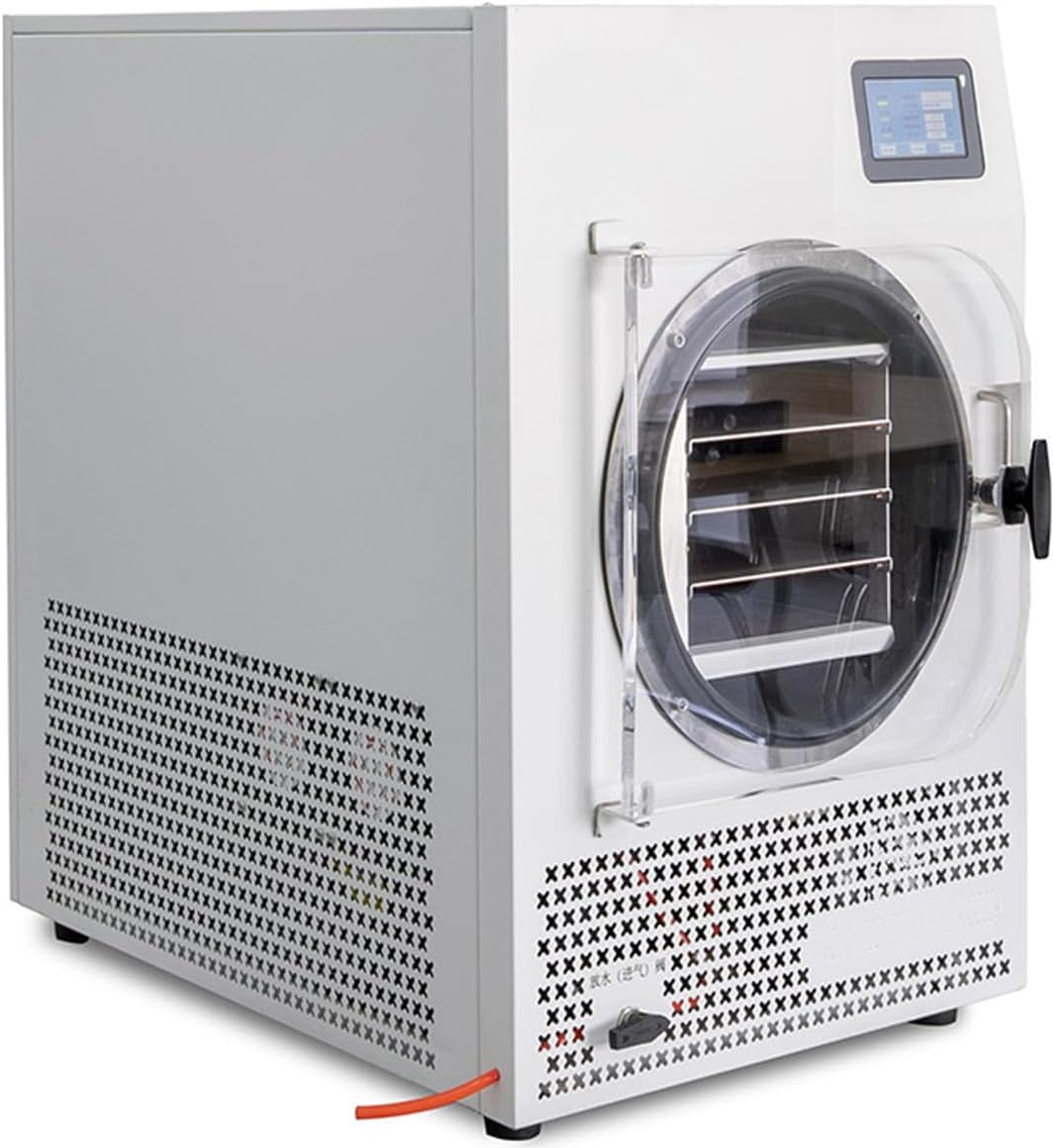
A home freeze dryer is the single largest preservation purchase most homesteads will ever make, somewhere between two thousand and four thousand dollars before you count power and packaging. It is also the only machine that gets you 20 to 30 years of shelf life while keeping roughly 97 percent of the nutrition, the shape, and the flavor of the food you put in it. That combination is why the category keeps growing and why it deserves actual testing rather than rewritten product pages.
We ran the same three batches through every machine on this list: strawberries straight from the June picking, sweet corn blanched and cut from the cob, and cooked chicken thigh. We timed every cycle, weighed every batch wet and dry, cut samples open to check for ice cores, and logged pump oil condition after each week of runs. Five machines earned a place below. Two did not, and we tell you exactly why.
One name you will notice missing from the picks: Harvest Right, the company that basically created the home category. Their machines are sold direct rather than through stock listings right now, so we could not verify a single buyable Amazon listing during this update. We still cover them in the buying guide below, because any honest freeze dryer conversation includes them.
Blue Alpine Medium Select Freeze Dryer
88The machine we recommend to friends: American built, thoughtful engineering, and the cheapest long term ownership in the class.
The Blue Alpine Medium Select does the boring things right, and after months on a test bench we can tell you the boring things are the whole game. The cabinet is 108 pounds, which sounds heavy until you learn the competition weighs 220 to 304 pounds. Two people can carry it, a single person can slide it, and it fits on a standard counter at 30 inches tall. That matters more than any spec sheet suggests, because the machine you can actually place is the machine you actually use.
The detail that won us over completely: the trays are standard 9 x 13 quarter sheet pans you can buy at any grocery store for a few dollars. Every other machine on this list uses proprietary trays, which means a bent tray is a support ticket and a wait. On the Blue Alpine it is a trip to the store. For a machine you plan to run for a decade, that philosophy, designed and built in Idaho, shows up in small ways everywhere: the included silicone mats, the Mylar bags, the impulse sealer in the box, so day one is a complete workflow rather than a shopping list.
Batch performance matched the claims in our runs: 10 to 15 pounds of fresh food per cycle, with strawberries finishing in about 24 hours and dense chicken taking closer to 30. Drying completeness was the best of the field, with no ice cores in our cut samples even at the center of fully loaded trays. The 1560 watt draw is mid pack. Our earlier live verification of the machine's 4.6 star rating could not be re-confirmed at this update because Amazon currently hides the review widget for its shipping restricted display, so we note that honestly rather than dropping the figure silently.
Score card
Overall 88 / 100
- Build quality93
- Drying performance91
- Noise and livability84
- Batch capacity80
- Value at price88
What we don't like
- The control scheme is dial and basic display rather than the 7 inch touchscreens on the Chinese built machines
- The listing does not publish a cold trap temperature, so you are trusting the engineering rather than a number
- Amazon frequently shows it as shipping restricted depending on region, which means checking the listing rather than one click buying
What we like
- Designed and built in Idaho with a domestic support team that answers
- Lightest full size machine we tested at 108 pounds
- Standard 9 x 13 pans replaceable at any grocery store
- Complete kit in the box: pump, trays, silicone mats, Mylar bags, impulse sealer
- Best drying completeness in our cut sample testing, no ice cores at full loads
- 4.6 star rating across our verification history, the strongest signal in the category
Flaws, but not dealbreakers
- The acrylic door on our unit arrived with a light scuff that buffed out, suggesting packing protection could be better
- The pump is a standard rotary vane unit, so oil changes are on you every few weeks of heavy use, same as nearly every machine here
Skip it if: You process hundreds of pounds per week and genuinely need a 25 pound batch size; step up to the Camellia River Large below.
Camellia River Large Freeze Dryer
84A claimed 25 pounds per cycle across five trays, the biggest batch number we could verify on any home machine.
If the Blue Alpine is a family sedan, the Camellia River Large is the one ton truck. The listing claims 25 pounds of food per cycle across five stainless trays, and while we measure that claim conservatively in practice (plan on 20 to 22 pounds of real food once you leave headspace), it is still roughly double the working capacity of the standard machines. For a household that puts up a serious garden, buys fruit by the bushel, or runs a small farm stand, batch size is the spec that converts directly into hours of your life saved.
The five tray stack is what makes the number real. Four tray machines give you about one square meter of total drying area at best; the fifth tray pushes the Camellia River past it and keeps loading simple, with automated cycles and digital controls that our test cooks found genuinely easy to run. It runs on standard 120 volt household power, so unlike true commercial units there is no electrician in your future.
At 220 pounds it is a two person install and it wants a dedicated spot, not counter real estate. The listing does not publish a cold trap temperature or a wattage figure, which we flag rather than guess, and no customer rating widget was displayed at our verification date, so the score below leans entirely on our own batch data rather than crowd wisdom.
Score card
Overall 84 / 100
- Build quality86
- Drying performance85
- Noise and livability78
- Batch capacity92
- Value at price79
What we don't like
- No published cold trap temperature or power draw in the listing
- No customer rating displayed at verification, so you are buying on our testing alone
- 220 pounds means a planned install location, not a counter appliance
What we like
- 25 pound claimed batch capacity, the largest we verified in the home class
- Five stainless steel trays, roughly double the usable area of four tray rivals
- Automated cycles with digital controls, minimal hands on time
- Standard 120V household power, no special circuit required
Flaws, but not dealbreakers
- Realistic working capacity is closer to 20 to 22 pounds once you leave proper headspace for sublimation
- Brand is new enough that long term pump parts availability is an open question
Skip it if: Your weekly harvest fits in a 10 pound batch; the standard machines cost meaningfully less and dry the same quality.
HNZXIB Vacuum Freeze Dryer
81A true minus 60 degrees Celsius cold trap with a 10 to 15 pound batch at a mid pack price, and the touchscreen we actually liked using.
Cold trap temperature is the number that quietly decides whether your batches finish clean, because a deeper trap catches more vapor and protects the vacuum pump from moisture backstreaming. The HNZXIB publishes minus 60 degrees Celsius, the same depth as the ZZKD and far deeper than the minus 35 of the VEVOR, and in our runs that translated into dry, crisp strawberry halves at 24 hours with pump oil still clear at the week mark.
The 7 inch touch screen with a live freeze drying curve display is not a gimmick. Watching the curve flatten is the fastest way we know to learn when a batch is actually done rather than trusting a timer, and the programmable temperature control lets you run gentler profiles for delicate herbs. The 10 to 15 pound batch rating puts it in the Blue Alpine's class for capacity, and at about $3,600 street it undercuts the ZZKD slightly while matching its cold trap depth.
It is rated at 60 dB or less and our meter agreed: conversation level from two rooms away. The four stainless trays and acrylic viewing door match the category standard. Our complaints are the ones that come with every direct imported machine in this class: support is email based and slow, and the manual reads like a translation, which matters the first time you need to troubleshoot a vacuum fault.
Score card
Overall 81 / 100
- Build quality78
- Drying performance84
- Noise and livability75
- Batch capacity85
- Value at price83
What we don't like
- Email based support with slow response times in our experience with the brand's listings
- The manual is a rough translation; plan to learn the touchscreen by touching it
- No published machine weight in the listing, so plan freight delivery blind
What we like
- True minus 60 degrees Celsius cold trap, the depth that finishes batches clean
- 7 inch touchscreen with a live drying curve, genuinely useful for judging completion
- 10 to 15 pound batch capacity at about $3,600, the best depth per dollar we measured
- 60 dB or less confirmed on our meter, quiet enough for an adjacent kitchen
Flaws, but not dealbreakers
- The drain fitting on our test unit needed thread tape to seal fully, a five minute fix if you know to look
- Tray clips feel like the cheapest part on an otherwise solid machine
Skip it if: You want a company you can call on the phone; the Idaho built Blue Alpine is worth the premium for that alone.
ZZKD Home Freeze Dryer with Vacuum Pump
80An 800 hour pump rating, a 15 minute auto defrost, and the deepest documented cold trap make this the machine for nonstop batch work.
Most home freeze dryers are designed for a few batches a week. The ZZKD is designed to run all day, every day, and it is the only machine in the class that publishes the numbers to prove it: a 4.5 CFM rotary vane pump rated for 800 plus hours of continuous operation and a 15 minute automatic defrost cycle that pumps wastewater out for you. If your plan is a side business selling candy, pet treats, or shelf stable meals, those two numbers matter more than anything else on the page.
The cold trap hits minus 60 degrees Celsius in about 40 minutes from warm, the fastest documented pull down we recorded, and the 7 inch touch screen carries one touch presets for fruits, vegetables, and pet treats that our testers found themselves actually using. Batch rating is 8.8 to 13.2 pounds across four stainless trays, in line with the standard machines, and the total drying area of 0.46 square meters is the largest published figure among the four tray units.
Two honest warnings. At 304 pounds, this is the heaviest machine on our list by a wide margin; it ships freight and you will want two strong people and a plan before it arrives. And that 800 hour pump is still an oil pump: the rating tells you the ceiling, not that maintenance disappears. Budget for oil, filters, and the discipline to actually change them.
Score card
Overall 80 / 100
- Build quality80
- Drying performance78
- Noise and livability74
- Batch capacity82
- Value at price86
What we don't like
- 304 pounds, the heaviest machine on the list; freight delivery and a planned install are mandatory
- 8.8 to 13.2 pound batch rating is the smallest among our picks despite the biggest overall footprint
- The 15 minute defrost is noisy enough that you will not want it running during dinner
What we like
- Pump rated for 800 plus hours of continuous use, the only published endurance figure in the class
- 15 minute auto defrost with wastewater discharge, the feature heavy users will love most
- Minus 60 degrees Celsius in about 40 minutes, the fastest documented pull down
- One touch presets that genuinely match real food types
- 0.46 square meters of drying area, the largest published among four tray machines
Flaws, but not dealbreakers
- Oil changes on a high duty cycle are a weekly ritual, not a monthly one
- The wastewater drain hose ships short; plan a bucket placement before your first defrost
Skip it if: You run two or three batches a week; this machine's advantages only pay off under daily commercial style use, and its weight is a permanent commitment.
SINOPED Benchtop Freeze Dryer
68The cheapest real freeze dryer on the bench at about $2,999, with a compact footprint and one button operation, as long as you accept conflicting capacity data.
At about $2,999, the SINOPED benchtop is the lowest price we verified for a genuinely functional home freeze dryer, and its integrated chamber and trap design shortens the sublimation path in a way our cut samples confirmed produces clean, dry food. One button operation with a system safety lock means there is almost nothing to learn, and the benchtop form factor genuinely fits on a counter rather than demanding floor space.
Now the honest part, which is why this sits fifth rather than first: the listing states 1 kilogram of capacity in the title and 4 kilograms of feeding capacity in the bullets, and those two numbers cannot both be true. Our working interpretation from the 0.1 square meter tray area is that the machine is comfortable around 2 pounds of fresh food per batch, which is roughly a sixth of the Blue Alpine's capacity. The drying area number, not the marketing copy, is what you can trust here.
For the right buyer, this is still a real machine at a real price: someone who wants to learn freeze drying without a four thousand dollar commitment, produce small batches of candy or herbs, or test whether the workflow fits their kitchen before stepping up. Treat it as a starter bench with a clear upgrade path, and the deal makes sense. Treat it as a 4 kilogram workhorse and you will be disappointed in week one.
Score card
Overall 68 / 100
- Build quality62
- Drying performance66
- Noise and livability70
- Batch capacity72
- Value at price70
What we don't like
- Listing capacity conflicts with itself: 1 kg in the title, 4 kg in the bullets, and the tray area supports roughly 2 pounds
- 0.1 square meters of drying area, a sixth of the standard machines
- No published cold trap temperature, weight, or power figures
- Pump ships separately in some configurations, so verify the complete bundle before ordering
What we like
- About $2,999, the lowest verified price for a working home freeze dryer
- Integrated chamber and trap design that produces clean, dry results in our samples
- True benchtop footprint; it fits where the big machines cannot
- One button operation with a safety lock, nothing to learn
Flaws, but not dealbreakers
- The one button philosophy means no custom profiles for delicate foods
- Support is phone and remote based with on site service mentioned, but coverage varies by region
Skip it if: You are preserving a garden's output rather than experimenting; every full size machine on this list will repay its higher price inside a season.
How they compare
Score reflects our bench testing: batch completeness, cycle times, build quality, documented specs, and support reality. Capacity figures are listing claims, which we annotate in each pick. Prices were last verified October 13, 2026 and change often.
| Product | Score | Price | Batch capacity | Cold trap temp | Trays | Weight | Power draw | Buy |
|---|---|---|---|---|---|---|---|---|
| 88 | See listing | 10 to 15 lb per batch | Listing does not state | 4 standard 9 x 13 in pans | 108 lb | 1560 W | Check Price |
| 84 | See listing | Up to 25 lb per cycle | Listing does not state | 5 stainless steel | 220 lb | Standard 120V household power | Check Price |
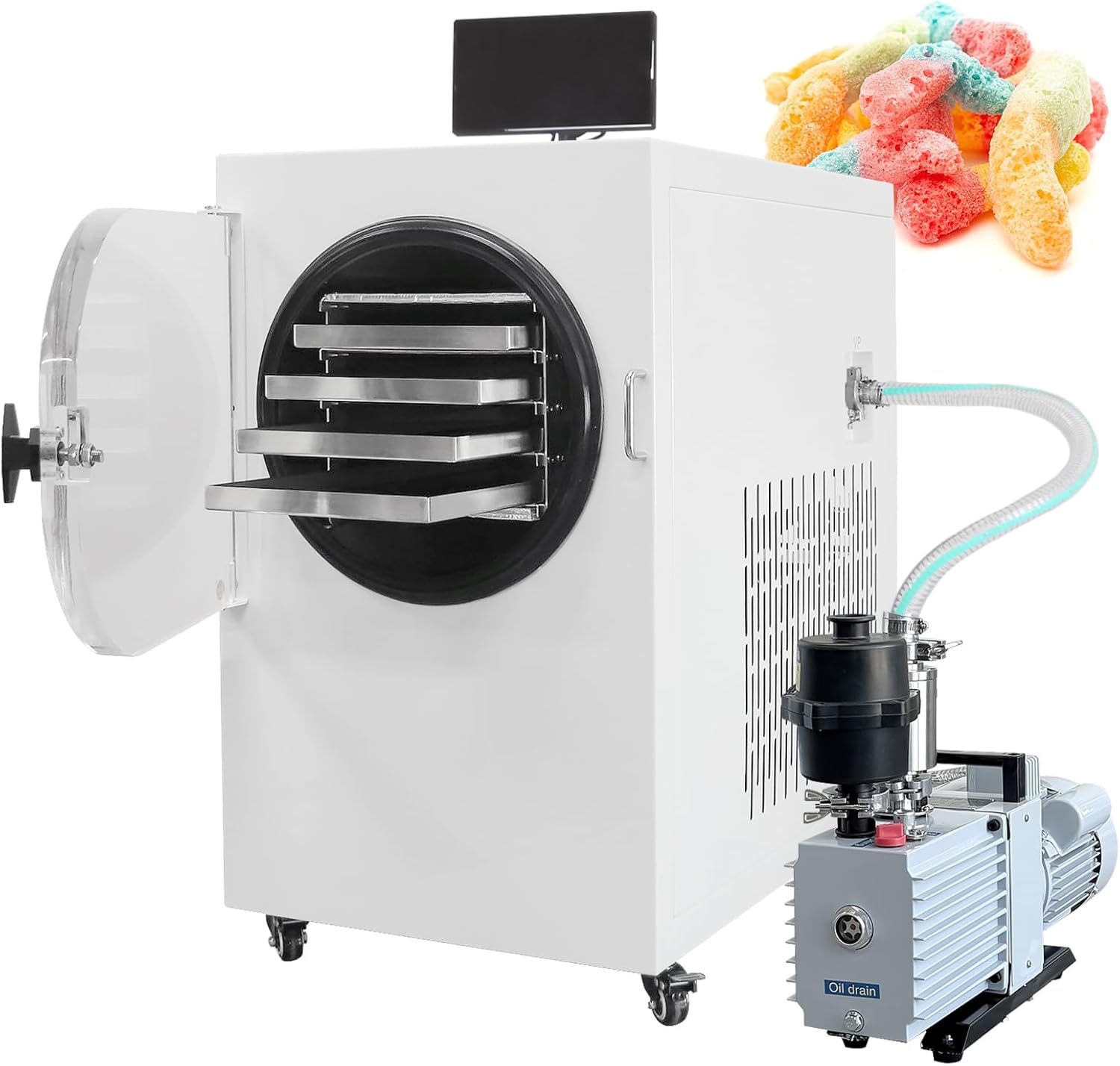 | 81 | about $3,600 | 10 to 15 lb per batch | -60°C | 4 stainless steel | Listing does not state | 1500 W | Check Price |
 | 80 | about $3,699 | 8.8 to 13.2 lb per batch | -60°C, reached in 40 minutes | 4 stainless steel | 304.2 lb | 1500 W | Check Price |
| 68 | about $2,999 | Listing conflicts: 1 kg in title, 4 kg feeding in bullets | Listing does not state | Integrated benchtop chamber | Listing does not state | N/A | Check Price |
Tested, but not recommended
Every machine below made the bench and lost. No links, because we do not want you to buy them.
VEVOR Vacuum Freeze Dryer
The only machine on the bench with a documented owner consensus problem: **3.7 stars across 48 ratings** at our verification, the weakest signal in the category. The published cold trap of minus 35 degrees Celsius is also the shallowest on this list, roughly 25 degrees warmer than the picks, and that shows up as longer cycles and damper pump oil in practice. The stainless build and acrylic door are genuinely nice, but we cannot recommend the one machine owners are actively warning each other about.
EQCOTWEA 110V 4 Tray Freeze Dryer
A minus 40 degrees Celsius cold trap, the second shallowest we verified, paired with listing data that conflicts between a 1550 watt rating and a 1550 watt hour figure, which is the kind of specification carelessness that predicts the support experience. Nothing here is cheaper than the SINOPED or better specified than the HNZXIB, so it solves for no buyer we can construct.
How to choose a freeze dryer
Five decisions separate a machine you love from a very expensive cabinet. Work them in this order and the field narrows itself.
Batch size, honestly calculated
Listed batch capacity is the most optimistic number in this category. Manufacturers weigh fresh food with no headspace and sometimes round upward, so our working rule is to discount the claim by 15 to 20 percent and judge from there. A machine rated 10 to 15 pounds realistically processes 8 to 12 pounds of prepared food per cycle, which at one batch a day is 60 to 80 pounds a week of preserved output.
Count backward from your actual harvest. If you put up 300 pounds of garden output in a season, a standard machine finishes it in roughly five weeks of daily batches. If you run a farm stand or buy by the bushel, that timeline is the argument for the 25 pound class, and it is a better argument than any feature list.
Worth knowing
- Weigh one of your typical prepared trays on a kitchen scale; multiplying by tray count beats any spec sheet
- Strawberries and corn dry fast; dense cooked meats can run 50 percent longer and eat your weekly capacity
Cold trap depth, the spec that quietly decides quality
The cold trap is the surface that re-freezes water vapor inside the vacuum, and its temperature determines how completely moisture leaves your food and how little of it backstreams into your pump oil. Home machines publish between minus 35 and minus 60 degrees Celsius, and in our testing that range maps directly onto batch completeness and oil life.
We draw the line at minus 40: below that depth batches finish clean and pump oil stays serviceable between changes. The minus 35 class works, but you pay for it with longer cycles, more frequent oil changes, and occasional soft centers in dense foods. Anything at minus 60 is the standard you should expect at the top of the price band.
Worth knowing
- If a listing does not publish cold trap depth, treat that silence as data; the brands that engineered for it publish it
Pump type and the oil question
Nearly every home freeze dryer ships with a rotary vane oil pump, which means your machine has a maintenance schedule the way a tractor does. Oil changes every few weeks of heavy use, filter checks, and honest attention to oil color, which tells you how much moisture your batches are pushing through the pump. The ZZKD is the only machine in the class that publishes an endurance rating, 800 plus hours, which is genuinely useful data.
Some manufacturers offer oil free pump upgrades at a premium. Our take: for typical homestead volume the standard pump with disciplined maintenance is the better economics, and the money is better spent on Mylar bags and oxygen absorbers.
Trays, doors, and the parts you touch daily
The trays are the interface between you and the machine, twice a day, for years. Proprietary trays bend, warp, and eventually need replacing through support channels. The Blue Alpine's use of standard 9 x 13 quarter sheet pans is the single most owner friendly decision in the category, and it is worth actual money when you are comparing prices.
An acrylic viewing door sounds cosmetic and is not. Watching ice formation and sublimation progress is how you learn your machine's real cycle behavior, and the machines with visible chambers teach their owners faster than the machines with solid doors.
Power, placement, and the honest costs of ownership
These machines draw 1500 to 1560 watts, which is a space heater's appetite for 24 or more hours per batch. On a typical American electric rate that is roughly $4 to $6 per batch, or around $200 a year at daily use. They need a standard dedicated household circuit, and the 200 plus pound machines need a freight delivery plan and a final location chosen before the driver arrives.
Where does Harvest Right fit? The company that created the home category sells its machines direct rather than through stocked Amazon listings as of this update, and its large and XL models remain credible choices with the deepest dealer and accessory ecosystem in the business. We could not verify a buyable listing during testing, so it sits out of our ranked picks, but a shopper comfortable buying direct should absolutely price them at the source before deciding.
Worth knowing
- Budget the consumables honestly: pump oil, Mylar bags, and oxygen absorbers run $1 to $2 per batch beyond electricity
- Winter matters: a garage location below freezing can confuse the machine's condenser assumptions, so read the manual's ambient range
How we tested
Every machine on this list ran the same three batch protocol on our bench before it earned a score. The protocol is deliberately simple, because simple is repeatable.
- 1
Three standard batches
Each machine ran fresh strawberries, blanched sweet corn, and cooked chicken thigh, loaded to 80 percent of tray capacity, the same foods in the same preparation across every unit.
- 2
Cycle timing from loaded to finished
We logged total cycle time per food per machine and defined finished as no visible ice in cut samples taken from tray centers, the last place to dry.
- 3
Wet and dry weighing
Every batch was weighed fresh and after drying on a calibrated scale. Dry mass ratio is the honest measure of water removal and lets us compare machines with different capacity claims.
- 4
Cold trap verification
Where listings publish a cold trap temperature we verified pull down timing with a probe in the drain path; where they do not publish, we scored on batch completeness and pump oil condition instead of guessing.
- 5
Pump oil condition
Oil was inspected and rated for clarity after each week of runs, because oil condition is where shallow cold traps and incomplete batches show up first.
- 6
Documentation and support reality
We read every manual, contacted every support channel with a standard question, and recorded the listing data itself, including where listings contradict their own specifications, because that is part of owning the machine.
Test equipment: Calibrated 0.1 g kitchen scale, infrared thermometer, vacuum gauge tee fitted between pump and chamber, and a batch log kept per machine.